Hanford Page
This page provides information on the activities at Hanford and its impact on the environment and surrounding communities. Additional information will be added to this page as it is received.
Hanford, Richland Operations, Dept. of Energy
Columbia River United
P.O. Box 912, Bingen, WA 98605
P.O. Box 1254, Hood River, OR 97031
(509) 493-2808 or (503) 387-3030
The following text and maps were excerpted with permission from the document "Hanford and the River" produced by Columbia River United, and researched and written by Gregory deBruler, Hanford Technical Consultant. For the complete document and additional publications, please contact Columbia River United at the above address.
Hanford Yesterday and Today
In January 1943, Hanford was chosen as a site for the government's top-secret Manhattan Project. The mission was to produce plutonium for the nuclear bomb. It was selected because of its remoteness, its abundant water for reactor cooling, and its plentiful electricity from hydroelectric dams. In the spring of 1943, 1200 residents were evacuated from the town of Hanford, White Bluffs, and Richland. Access was denied to Native Americans who had historically used the lands for hunting, food gathering, and religious purposes. The world's first three plutonium production reactors were quickly built with a work force of 51,000. Just 27 months after construction started, Hanford-produced plutonium provided the explosive charge for the world's first nuclear detonation in Alamorgordo, New Mexico. Not long after, the Nagasaki bomb was powered by concentrated plutonium manufactured at Hanford.
Government demand for plutonium continued, and by 1964, nine plutonium production reactors were operating at Hanford discharging their deadly wastes directly into the Columbia River. Chemical and radioactive discharges contaminated the soil, water, and air with little care for containment and little knowledge of the dangers of the wastes being produced. At least once, radioactive materials were discharged into the air for purposes of experimentation on the American public. In 1949, the famous Green Run released over 5500 curies of iodine-131 in one day, as well as other fission products (by comparison, Three Mile Island released 15-24 curies). With the help of the wind, these dangerous radioactive particles were distributed over much of Washington and Oregon. In the year 1945 alone, 340,000 curies of iodine-131 were emitted to the air from Hanford. Today, the government is studying the link between thyroid disease and some of these releases.
The Columbia River received much larger amounts of radionuclides. In 1954 alone, it was estimated almost 3 million curies (2,912,000) were released into the River (Doc. #HW32809). Large releases to the River continued for over thirty years and discharges are still occurring today! The impact is currently a matter of debate and speculation. The information kept secret for so long is slowly being revealed. The actual total releases to the River may never be known.
Today the official mission at the Hanford site is environmental restoration. It is called clean-up, but the word is misleading. The best we can hope for is to contain most of the deadly wastes from this massively contaminated site, preventing them from further contaminating the Columbia River. What is being termed "clean-up" is an overwhelmingly difficult job that will take an estimated one hundred billion taxpayer dollars and over thirty years to accomplish. Columbia River United has been monitoring the activities at Hanford for over five years now and has seen hopeful changes as a result of public participation and incorporation of public values. To protect the future of the Columbia River we need your help! The first step is to become knowledgeable. Please read on!
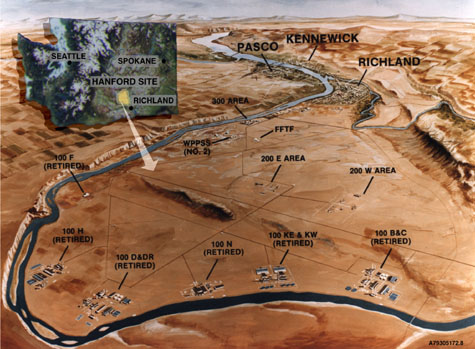
Major Areas Impacting the Columbia River
The 100 Area
This is the area where nine nuclear reactors were built between 1944 and 1964. They were located beside the Columbia River to utilize the waters of the River for cooling. The first to be built was the B reactor. By 1955, there were eight plutonium producing reactors along the river. All of these were production reactors designed to irradiate uranium fuel rods to create plutonium. This was the largest number of production reactors to be placed on one river anywhere in the world. These radioactive discharges to the River resulted in Oregon State's Public Health Division declaring the Columbia River the most radioactive river in the free world in the 1960's.
The direct release of all of these reactors' untreated cooling waters was the single largest source of contamination to the River from the Hanford site. An Atomic Energy Commission/General Electric document from 1954 stated that releases to the River were approximately 8000 curies of radiation per day (doc. #HW32809). Concern was expressed in that document about the high radioactivity in the river, "...with projected increases 5 to 10 fold." If these estimated increases were correct, between 15 million and 30 million curies of radiation were released to the Columbia River annually in the late 1950's and early 1960's. The document goes on to state, "It may be necessary to close public fishing between Priest Rapids and McNary Dam. The public relations impact would be severe. "Using their calculations, by 1960, more radiation was released than in the 1986 nuclear accident at Chernobyl. In addition to the reactors, past disposal practices from 21 cribs and 19 trenches have resulted in numerous leaks and spills which contaminated groundwater and are ongoing sources of radioactive and chemical contamination to the River today. N. Springs is a visible flowing stream entering the Columbia River. (This ongoing source is discussed further in the printed document available through Columbia River United.)
The 200 Area
This centrally located site is the most grossly contaminated area in North America and possibly the world. This area was used for chemical separation of plutonium from the fuel rods irradiated in the nine production reactors. Facilities in the 200 area include the PUREX plant built in 1956, the REDOX facility built in 1953, the B plant built in 1945, and the T plant built in 1944. These are the sources of contaminant plumes in the 200 Area. Billions of gallons of liquid radioactive and chemical waste were released annually to the soil column. The 200 Area is also the location of 177 underground storage tanks of high level radioactive and chemical waste. 149 of these tanks are single shell tanks constructed between 1943 and 1964. Sixty-eight of these tanks are confirmed leakers. In the 200 Area alone, over 121 million gallons of tank waste were discharged to the soil between 1946 and 1966. These tanks continue to leak today, discharging their deadly contents into the ground. In addition, sixty of these underground tanks are on a DOE "Watch List" for possible explosion. The four potential causes are ferrocyanide, hydrogen gas buildup, organic chemical combinations, and high heat.
The 300 Area
This area, where uranium was fabricated into fuel rods is another source of contamination to the Columbia River. These fuel rods were used in the production reactors which produced plutonium. These facilities are known as fuel fabrication facilities. In addition, chemical and radiological laboratories and research and testing facilities are located here. One crib and four trenches are located only forty feet from groundwater and a few hundred feet from the River. Thirty leaks and spills have been reported and a uranium plume that reaches the River exceeds drinking water standards. (See the plume map in the next section on Groundwater Plumes.)
There are other areas of Hanford that are sources of contamination
past and present, but these are the major ones affecting the Columbia River.
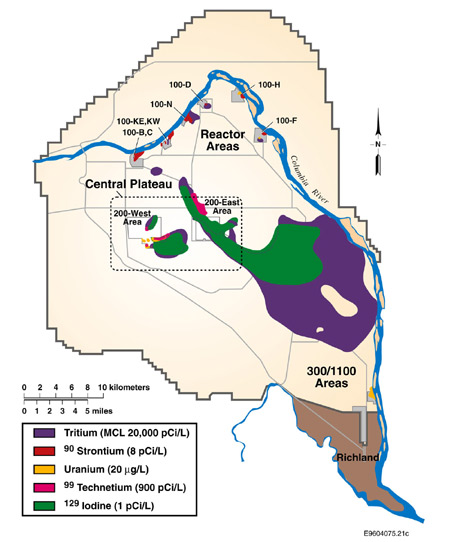
Hanford Contamination Has Resulted in Massive Groundwater Plumes
- Over 444 billion gallons of radioactive and chemical waste have been discharged to the soil at the Hanford site.
- Hundreds of billions of gallons of wastewater were discharged directly into the River.
- Soil and groundwater contamination have resulted in massive underground plumes of deadly materials moving towards and in some cases already reaching the Columbia River.
- The largest site plumes are the nitrate and tritium plumes. Other large plumes include uranium, strontium-90, and chromium. (Maps of these individual plumes are included in the printed version of this document, available through Columbia River United.)
- Other contaminants of major concern include carbon tetrachloride, sodium dichromate, technitium-99, and ferrocyanide.
- All groundwater contamination in the 200 Area exceeds drinking water standards making the groundwater unusable.
- Ongoing discharges to the soil are a cause for concern for CRU because any discharges to the soil column, EVEN OF CLEAN WATER, can increase the flow of contaminants towards the River.
- Estimates of travel time for various contaminants from the 200 Area to the River now include travel time possibilities of shorter duration than previous estimates. For some contaminants the travel time is now estimated to be only 5 to 10 years.
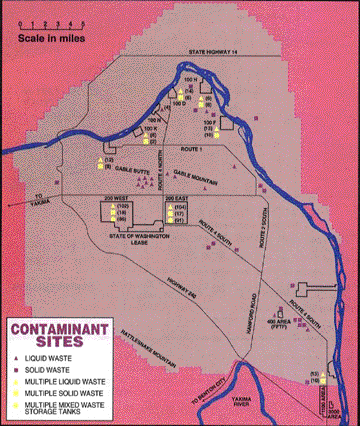
- There are over 1400 waste sites identified at Hanford. There may be many more. These sites contain liquid wastes, solid wastes, or both. The liquid wastes range from cribs, trenches, and ponds to liquid stored in barrels. The solid waste sites range in contents from things like buried tools and clothing to high level radionuclides in containers. (Maps of the individual plumes are included in the printed version of this document, available through Columbia River United.)
Hanford Tomorrow?
The revised Tri-Party Agreement was signed on January 25, 1994 as a legally binding document between the State of Washington, the U.S. Department of Energy (DOE), and the U.S. Environmental Protection Agency (EPA). Its purpose is to govern the "clean-up" of the Hanford site.
Actual "clean-up" work is being directed by the Department of Energy with oversight by the EPA and the Washington State Department of Ecology. Some agency workers at the site have shared their view with CRU that the document is worthless unless there is increased oversight and enforcement. One distressing fact is that the EPA only has six employees working at Hanford. We also are dealing with a situation whereby the same agency and its contractors that created the problem are in charge of cleaning it up.
There is a great deal of money to be made on the clean-up with more people working at Hanford now than ever before except during construction. New technologies must be developed and utilized. Simple, existing technologies that will help remediate the problems, like groundwater, must be implemented now, before it is too late.
CRU has seen dramatic changes at Hanford in the past few years. Citizen advisory boards have been formed on which CRU has represented citizens living along the Columbia River. One of these boards was the Hanford Future Site Uses Working Group that developed possible visions for the future of Hanford. CRU feels it is an important step to be looking at possible futures for the site. CRU's participation on this group was instrumental in the adoption of the board's first recommendation "PROTECT THE COLUMBIA RIVER." Another citizen advisory board of importance is the Hanford Advisory Board which held its first meeting in January, 1994. CRU represents Columbia River citizens on this board as well. This is a permanent board to review and put forth recommendations on the "clean-up" process at Hanford.
Public participation is the key to achieving the best possible clean-up of the Hanford site and protection of the Columbia River. We have learned from the past that corporations and our government do not always consider what is in the best interest of the public or the environment. We can not allow those who think of short term profits instead of the impact on future generations to guide this process. It was that sort of thinking which caused this crisis and we need to take a much different approach if we want clean-up to succeed. An open competitive bidding process is necessary to keep taxpayer costs as low as possible so clean-up is allowed to proceed in order to do what is truly necessary to protect the interests of future generations. The public and Native American nations must be the guiding force in the clean-up of the Hanford Nuclear Reservation. This will require all of us working together for a long time to come.
The Future of the Columbia River Depends on Us.